 Jobboy

Introduction
In today's competitive job market, your resume needs to grab attention quickly. Recruiters spend just seconds scanning applications, so making your achievements pop is crucial. One proven way to do this is by quantifying your accomplishments with metrics and numbers. This guide will walk you through identifying key metrics from your past roles, crafting bullet points using the formula 'Action verb + task + result with numbers,' and providing real-world examples. We'll also cover how this approach helps with Applicant Tracking Systems (ATS), tips for non-numeric achievements, and strategies to impress recruiters.
Whether you're in sales, marketing, tech, or any field, adding quantifiable results turns vague statements into compelling evidence of your value. Let's dive in.
Identifying Metrics from Past Roles
Start by reflecting on your previous jobs. What did you actually accomplish? Metrics aren't just sales figures—they can include time saved, efficiency gains, customer satisfaction scores, or team productivity improvements. To uncover them:
- Review performance reviews: Look for feedback mentioning impacts, like 'increased team output' or 'reduced errors.'
- Check emails and reports: Search for data on projects you led, such as email open rates or budget savings.
- Ask former colleagues: They might remember specifics you overlooked, like how your initiative boosted engagement by 20%.
- Brainstorm categories: Consider revenue, costs, time, quality, and volume. Even soft skills can yield metrics, like training sessions delivered.
Don't worry if numbers feel scarce at first—many professionals overlook them. The key is specificity: instead of 'managed a team,' think 'led a 10-person team to deliver projects 15% under budget.' This mindset shift will transform your resume.
The Formula for Impactful Bullet Points
The golden rule for resume bullets is: Action verb + task + result with numbers. This structure showcases what you did, how you did it, and the outcome, making your contributions tangible.
- Action verb: Start strong with words like 'led,' 'optimized,' 'generated,' or 'streamlined' to convey initiative.
- Task: Briefly describe the responsibility or project, e.g., 'social media campaigns' or 'customer support processes.'
- Result with numbers: End with impact, using percentages, dollars, or counts. Aim for at least one metric per bullet.
Example: 'Developed marketing strategy that increased website traffic by 40% in six months.' This beats 'Handled marketing tasks' every time.
For more guidance on action verbs, check out resources from Indeed's career advice section.
Before-and-After Examples Across Industries
Seeing the transformation in action is eye-opening. Here are before-and-after bullet points from various fields, showing how quantification elevates your story.
Sales
Before: Sold products to clients and met quotas.
After: Exceeded sales targets by 25% annually, closing deals worth $500K with 50+ enterprise clients.
This version highlights revenue and volume, proving direct business impact.
Marketing
Before: Managed social media accounts.
After: Grew Instagram following from 5K to 20K followers, boosting engagement rates by 35% through targeted content campaigns.
Numbers on growth and engagement make the achievement measurable and impressive.
IT/Tech
Before: Fixed software bugs and updated systems.
After: Resolved 200+ critical bugs in legacy code, reducing system downtime by 60% and saving the team 100 hours weekly.
Here, time savings and error reduction demonstrate efficiency gains.
Healthcare
Before: Assisted patients and coordinated care.
After: Streamlined patient intake process for 150 daily cases, cutting wait times by 40% and improving satisfaction scores to 95%.
Patient volume and satisfaction metrics underscore patient-centered results.
Education/Non-Profit
Before: Organized events and tutored students.
After: Tutored 50 underprivileged students in math, raising average test scores by 30% and securing $10K in grants for program expansion.
Even in non-corporate roles, funding and score improvements add weight.
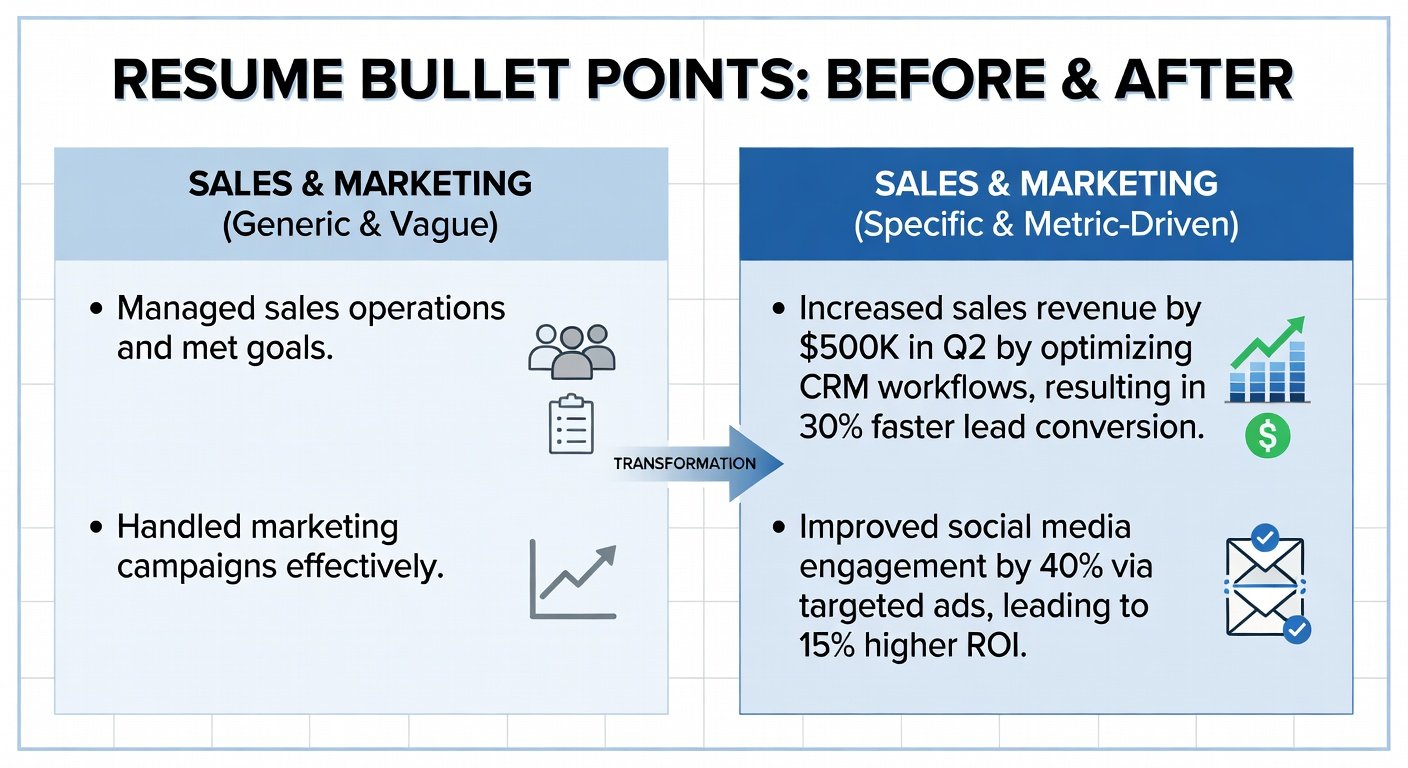
These examples span industries, but the principle applies universally. Tailor metrics to your field—recruiters in finance might prioritize ROI, while creatives value reach or conversions.
ATS Benefits: Why Numbers Matter for Tech
Most large companies use Applicant Tracking Systems to filter resumes. ATS software scans for keywords and quantifiable data to rank candidates. Vague bullets like 'experienced in sales' might get lost, but 'increased sales by 25%' matches job descriptions seeking 'revenue growth' metrics.
Quantified achievements help because:
- They include scannable numbers, which ATS algorithms favor.
- Action verbs align with parsed keywords from postings.
- Results-oriented language signals high performers, improving your score.
According to HR experts, resumes with metrics are 40% more likely to pass ATS filters. For best practices, visit the Society for Human Resource Management (SHRM) homepage for insights on modern hiring tech.
Tips for Non-Numeric Achievements
Not every win has a number—especially in roles focused on creativity, leadership, or early-career positions. Here's how to make them shine:
- Use descriptive impact: Instead of 'Led a project,' say 'Led cross-functional team through a high-stakes merger, ensuring seamless integration without disruptions.'
- Highlight qualitative outcomes: For 'Improved team morale,' try 'Fostered collaborative environment that reduced turnover by implementing feedback loops—substantiated by exit interviews.'
- Incorporate scope or scale: 'Developed training program for 200 employees' adds volume without hard metrics.
- Link to business value: Connect to broader goals, e.g., 'Pioneered eco-friendly initiative aligning with company sustainability goals, earning industry recognition.'
- Quantify where possible indirectly: If exact numbers escape you, estimate conservatively: 'Contributed to a 15% overall department efficiency gain.'
Remember, authenticity matters—recruiters can spot fluff. Focus on stories that demonstrate skills.
Making Your Resume Stand Out to Recruiters
Beyond metrics, tailor your resume for humans. Use consistent formatting, limit to one page if possible, and customize for each job. Place your strongest bullets under each role, starting with the most recent.
To really impress:
- Lead with impact: Put quantified bullets first in each section.
- Avoid jargon overload: Explain acronyms and keep language clear.
- Proofread rigorously: Typos undermine even the best metrics.
- Test with tools: Run your resume through free ATS simulators to ensure compatibility.
Finally, pair your resume with a strong LinkedIn profile echoing these achievements. Recruiters often cross-reference, so consistency builds credibility.
Conclusion
Quantifying your resume isn't just about numbers—it's about telling your professional story with proof. By identifying metrics, applying the action verb formula, and adapting for ATS and non-numeric wins, you'll create a document that demands attention. Start revising today: pull out old notes, craft those bullets, and watch opportunities roll in. Your career success is waiting—make it measurable.


No comments yet. Be the first!