 Jobboy

Introduction: Why Leadership Matters on Mid-Career Resumes
In today's competitive job market, mid-career professionals often face the challenge of demonstrating leadership potential without holding formal executive titles. Recruiters and hiring managers scan resumes for evidence of influence, team guidance, and measurable outcomes. This guide explores search intent around these elements, providing actionable steps to stand out in applicant pools throughout 2026. Many candidates undervalue informal leadership experiences such as guiding peers, improving processes, or mentoring newcomers, yet these elements frequently differentiate strong applicants from average ones. Effective leadership framing goes beyond listing duties. It involves selecting powerful verbs, quantifying team results, and crafting concise anecdotes that align with industry expectations. By the end of this article, you will have tools to transform generic bullets into compelling leadership narratives that resonate with both human readers and applicant tracking systems.
Selecting Powerful Action Verbs for Leadership Impact
Start by replacing passive language with dynamic verbs that imply initiative and direction. Words like "orchestrated," "mentored," and "spearheaded" convey authority even in non-managerial roles. Avoid overused terms such as "managed" or "led" when possible; instead, choose verbs that highlight specific influence. Consider the nuance each verb carries: "orchestrated" suggests coordination across multiple parties, while "mentored" emphasizes personal development of others. Review your current resume bullets and replace weak starters with stronger alternatives that better reflect your contributions. This small change often elevates the entire document and helps it pass initial screening stages.
- Orchestrated cross-functional projects resulting in streamlined workflows
- Mentored junior team members to accelerate skill development
- Spearheaded process improvements that boosted efficiency
- Championed diversity initiatives that improved team retention rates
- Navigated complex stakeholder negotiations to secure project approvals
These choices help ATS systems and human readers quickly identify leadership signals. Tailor verbs to your industry for maximum relevance and test variations against sample job postings.
Incorporating Quantifiable Team Outcomes
Numbers provide concrete proof of your influence. Focus on team size, project scope, and results achieved under your guidance. For example, instead of stating you supervised staff, note how your oversight contributed to specific gains. Structure bullets to lead with the verb, followed by context and metrics: "Directed a 12-person team through a six-month initiative that increased client retention by 18%." This approach demonstrates scale without requiring a C-suite title. When exact numbers are unavailable, use ranges or percentages that still convey magnitude. Always verify data accuracy to maintain credibility during interviews. Quantifiable examples build trust and allow recruiters to envision your potential impact on their organization.
Structuring Leadership Anecdotes Effectively
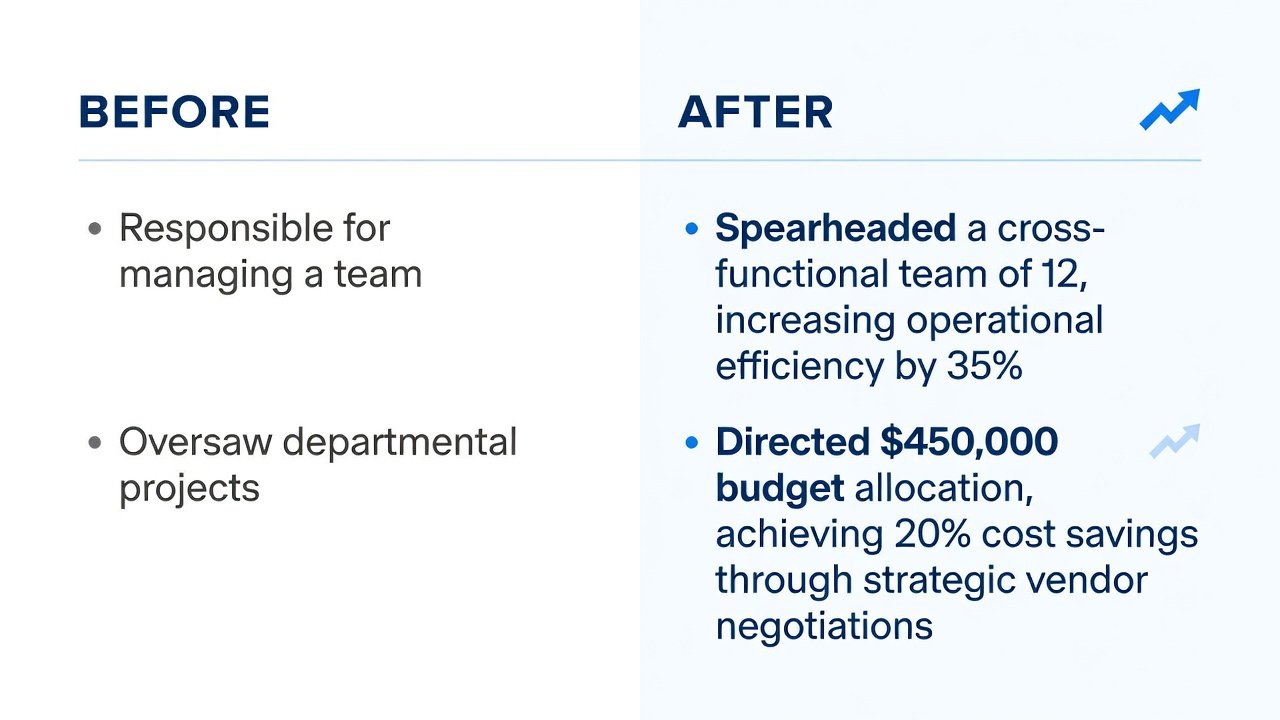
Condense stories into 1-2 lines using the CAR method: Challenge, Action, Result. Identify situations where you influenced peers, resolved conflicts, or drove collaboration. Keep anecdotes concise to maintain recruiter attention spans, which average under 10 seconds per resume section. Before: "Worked with team on sales targets." After: "Challenged declining quarterly performance by coaching five colleagues on negotiation tactics, resulting in 25% revenue growth." Expand this technique across multiple experiences to create a consistent narrative thread throughout your resume.
Before-and-After Bullet Examples
Review these transformations across common scenarios to see how small revisions create stronger leadership impressions:
- Before: "Participated in team meetings." After: "Facilitated weekly strategy sessions for eight colleagues, aligning priorities that reduced project delays by 30%."
- Before: "Helped train new hires." After: "Designed onboarding curriculum adopted department-wide, shortening ramp-up time from six weeks to four."
- Before: "Assisted with budget planning." After: "Coordinated input from seven departments to finalize a $450,000 annual budget that stayed 5% under projections."
Step-by-Step Identification Worksheet
Use this process to uncover hidden leadership examples from your work history. First, list three recent projects where you influenced outcomes beyond your core responsibilities. Second, note the number of people involved and your specific contributions, even if informal. Third, identify measurable results such as time saved, revenue impacted, or satisfaction scores improved. Fourth, refine into verb-led bullets under 25 words each. Fifth, review for ATS keywords like "collaboration," "strategy," and "influence" drawn directly from target job descriptions. Repeat the worksheet for every role on your resume to ensure comprehensive coverage.
Leadership Framing Comparisons Across Industries
Tech roles emphasize innovation and cross-team influence, often highlighting agile methodologies and product launches. Healthcare prioritizes patient outcomes and staff coordination, with examples centered on compliance and care quality metrics. In finance, focus on risk mitigation and regulatory compliance under your guidance, using precise figures for portfolio performance or audit success. Marketing positions value campaign leadership and audience growth, while education roles stress curriculum development and student achievement gains. Adapt examples accordingly to resonate with target employers and demonstrate industry awareness.
Common Mistakes to Avoid
Steer clear of vague claims or exaggerations that could surface in interviews. Ensure all metrics are accurate and verifiable through references or documentation. Overstatements often lead to disqualification during reference checks. Another frequent error involves burying leadership examples deep in paragraphs rather than using scannable bullets. Finally, neglecting to align language with the specific job posting reduces relevance and ATS scoring.
FAQ: Addressing Overstatements and ATS Concerns
How do I avoid sounding boastful? Stick to facts and team contributions rather than individual praise, framing achievements as collaborative efforts.
Will leadership examples pass ATS filters? Yes, when integrated with standard keywords from job descriptions. Test your resume using free tools from Indeed or LinkedIn.
What if my experience lacks direct reports? Highlight informal leadership through mentoring, project direction, or process ownership, which recruiters recognize as valuable indicators of potential.
How should I handle gaps in leadership visibility? Use volunteer roles or professional association activities to supplement examples where workplace opportunities were limited.
For additional resume resources, consult CareerOneStop for official guidance. Implement these strategies to position yourself as a leader ready for advancement in 2026 and beyond.
No comments yet. Be the first!