 Jobboy

Introduction: Why Transferable Skills Matter More Than Ever in 2026
Career changers in 2026 face a dynamic job market shaped by AI-driven hiring tools and evolving employer demands. Highlighting transferable skills on your resume allows you to bridge gaps between past roles and new opportunities, proving your value without relying on direct experience. This approach boosts ATS compatibility while capturing recruiter attention in seconds. Many professionals pivot due to industry shifts, personal growth, or emerging technologies, and those who successfully reframe their backgrounds often land roles faster.
Research from the U.S. Bureau of Labor Statistics shows continued growth in roles requiring adaptable skill sets across industries. By focusing on skills like project management, data analysis, and communication, you can reframe your background effectively. In today's environment, employers value adaptability over perfect industry matches, especially as automation changes traditional job requirements.
Understanding AI-Driven Hiring Tools in 2026
Modern applicant tracking systems now incorporate advanced AI that scans not just keywords but also context, sentiment, and skill relevance. Tools like those from major platforms analyze resumes for patterns in achievement language and quantifiable results. Career changers must optimize for these systems by using natural language that mirrors job postings while avoiding keyword stuffing that triggers filters.
Staying updated on AI trends means reviewing how platforms evolve. For example, some systems now prioritize skills demonstrated through metrics over job titles alone. This shift benefits pivots who can clearly link past accomplishments to new demands.
Conducting Keyword Research for Target Roles
Start by analyzing job descriptions in your desired field. Use tools to identify recurring terms such as "cross-functional collaboration" or "process optimization." Incorporate these naturally into your resume to align with ATS algorithms that scan for relevance in 2026 hiring systems. Visit authoritative resources like BLS.gov for labor market insights that reveal high-demand skills.
Compare multiple postings to find patterns. For instance, if transitioning from teaching to corporate training, keywords like "curriculum development" and "stakeholder engagement" become powerful bridges. Create a master list of 15-20 terms and weave them into bullet points without forcing unnatural phrasing.
Reframing Past Experience Without Highlighting Gaps
Instead of listing every previous job chronologically, group experiences by skill themes. This technique minimizes attention on employment gaps and emphasizes achievements that translate across fields. Focus on outcomes rather than job titles to maintain a forward-looking narrative. Career changers often worry about unrelated roles, but strategic reframing turns them into assets demonstrating versatility.
Avoid phrases that signal unrelated work. Transform retail management into "team leadership and inventory optimization" when applying for operations roles. Add context about how those experiences built resilience or problem-solving abilities valued in the target industry.
Using Quantifiable Metrics to Demonstrate Value
Numbers add credibility. Replace vague statements with specifics like "Improved team efficiency by 30% through streamlined workflows" or "Managed budgets exceeding $500K annually." These metrics show impact regardless of industry. In 2026, recruiters prioritize evidence-based resumes that quantify contributions to revenue, efficiency, or innovation.
Collect data from performance reviews, project reports, or personal tracking. Even soft achievements can be measured, such as "Trained 50+ team members resulting in a 20% reduction in onboarding time." This evidence-based approach strengthens your case during interviews too.
Step-by-Step Framework for Skill Translation
- Inventory your core skills from all experiences, including volunteer work and side projects.
- Map each skill to requirements in target job postings using a simple spreadsheet.
- Rephrase achievements using industry language found in current listings.
- Validate mappings with feedback from mentors or career coaches.
- Iterate based on application response rates and adjust for new trends.
- Cross-reference with resources like O*NET Online to confirm skill relevance in emerging roles.
This structured method ensures comprehensive coverage while staying authentic to your background.
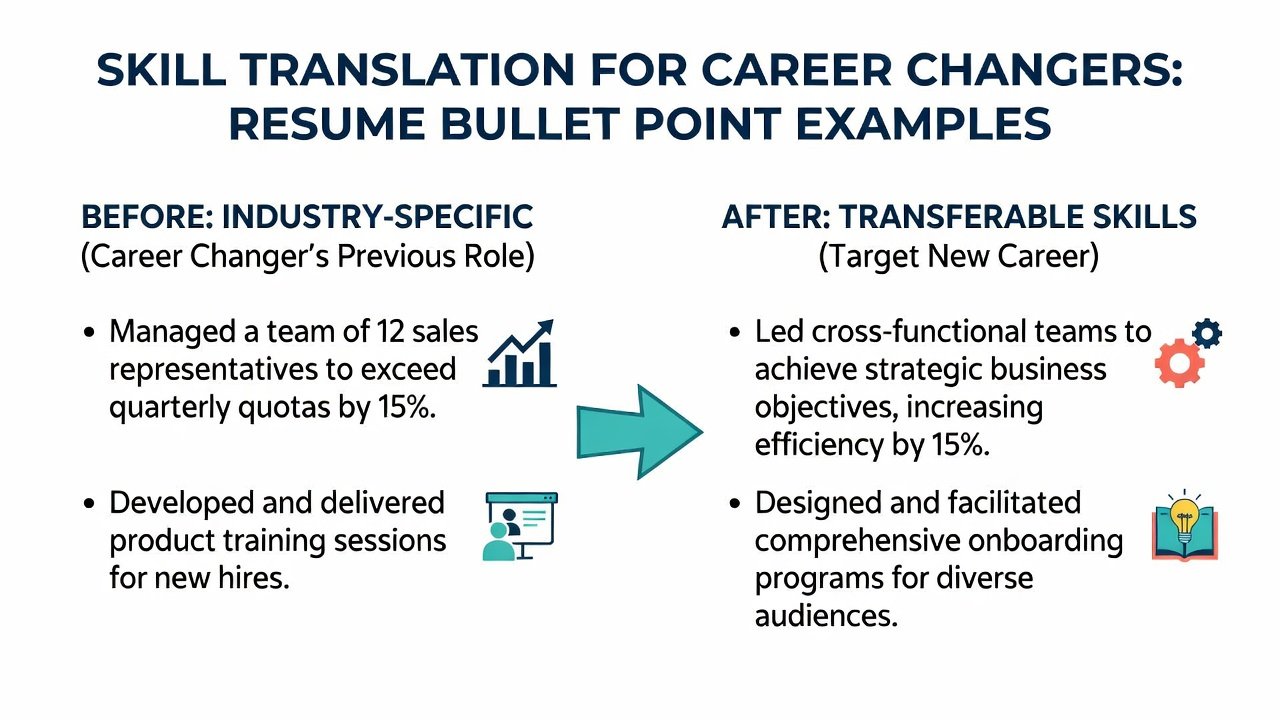
Real Before-and-After Bullet Point Examples
Before: "Handled customer complaints in a call center."
After: "Resolved complex client issues through active listening and problem-solving, achieving a 95% satisfaction rate and reducing escalations by 40%."
Before: "Taught high school science."
After: "Designed and delivered training programs on technical concepts, improving learner retention by 25% and adapting content for diverse audiences."
Before: "Coordinated community events for a nonprofit."
After: "Led cross-functional event planning initiatives that increased participation by 60%, demonstrating strong organizational and stakeholder management abilities transferable to corporate project coordination."
These transformations highlight transferable elements like communication and adaptability. Review your own bullets and apply similar upgrades for maximum effect.
Skills-Based vs. Chronological Resume Formats
A skills-based format leads with a dedicated competencies section, ideal for significant career pivots. Chronological resumes suit those with linear paths but can bury transferable strengths. In 2026, hybrid formats often perform best, combining a skills summary with concise employment history. Test both versions with ATS simulators to measure keyword density and readability scores.
Consider your pivot distance: larger changes favor skills-first, while modest shifts work well with hybrid approaches. Include a professional summary at the top that explicitly states your career transition goals.
Practical Downloadable Checklist for Career Changers
Include items such as: Verify keyword integration across all sections, quantify at least three achievements per role, remove irrelevant details older than 10 years, tailor for each application, and proofread for ATS-friendly formatting. Add checks for AI compatibility like avoiding tables or images that scanners cannot read. This checklist streamlines preparation and reduces common errors that derail applications.
Common Pitfalls to Avoid
- Overloading with buzzwords without context or supporting evidence.
- Ignoring AI screening by using complex graphics or tables that break parsing.
- Failing to connect skills explicitly to the new role's requirements.
- Listing every past responsibility instead of selective, high-impact highlights.
- Neglecting to update LinkedIn profiles to match resume messaging.
Steer clear of these to maintain professional impact and increase callback rates.
FAQs About Handling Unrelated Experience
How do I address completely unrelated jobs? Summarize briefly under a "Previous Experience" heading and redirect focus to relevant skills developed. Limit details to one or two lines.
Should I mention career gaps? Use a functional layout to de-emphasize timelines, or address proactively in a cover letter with positive framing around skill-building activities like certifications or freelance projects.
Can AI tools help optimize my resume? Yes, leverage AI for initial keyword suggestions but always personalize content for authenticity and accuracy.
What about volunteer or freelance work? Treat these as professional experiences when they demonstrate key skills, especially if they fill timeline gaps or showcase recent achievements.
Conclusion: Position Yourself for Success
By strategically highlighting transferable skills, career changers can thrive amid 2026 job market shifts. Implement these frameworks, review examples, and refine your approach for stronger applications and interviews. Start today to unlock new professional pathways and build a compelling narrative that resonates with both humans and AI systems.

No comments yet. Be the first!