 Jobboy

Introduction to 2026 Job Market Trends
The 2026 job market continues to evolve rapidly due to technological advancements, economic shifts, and changing workforce demands. Job seekers who move beyond basic networking and generic AI tools can gain a significant edge by adopting data-driven approaches. This guide provides intermediate-level hunters with actionable steps to monitor listings, analyze trends via free resources, and adapt strategies for quicker results. Understanding emerging patterns allows you to target opportunities in high-growth areas while avoiding oversaturated fields. By combining real-time data with strategic timing, professionals can reduce application-to-interview cycles substantially and focus efforts where demand is strongest.
Many candidates still rely on reactive searching, applying to every posting without context. In contrast, those who study market signals position themselves for roles that align with expanding sectors. This approach not only speeds up outcomes but also improves long-term career fit. Throughout this article, we break down proven methods, complete with examples and checklists you can implement immediately.
Monitoring Job Listings and Applications with Data
Effective job hunting in 2026 starts with systematic tracking rather than random applications. Free tools from government agencies and major job platforms enable users to spot trends early. For instance, the Bureau of Labor Statistics publishes monthly employment reports that highlight expanding industries. Setting up automated alerts on Indeed, LinkedIn, and Glassdoor using precise keywords tied to growth metrics helps capture new postings within hours of release.
Track application volumes weekly by noting how many candidates typically apply to similar roles. This data reveals optimal submission windows, such as early in the week when recruiters review new postings. Additionally, monitor geographic shifts by filtering results by city or remote options. Over time, patterns emerge showing which industries post consistently versus those with seasonal spikes. This monitoring phase forms the foundation for all subsequent strategy adjustments.
Analyzing Trends via Free Tools and Job Boards
Several no-cost resources simplify trend analysis. The U.S. Department of Labor's O*NET database at O*NET Online offers detailed occupational projections, while Google Trends helps gauge public interest in specific roles. Combine these with job board filters to compare posting volumes across regions and experience levels.
Practical steps include exporting data into spreadsheets, calculating month-over-month changes in listings, and cross-referencing with economic indicators from the Department of Labor. This process takes under two hours weekly but yields precise insights into where demand is rising. For example, a job seeker can query “data analyst” in Google Trends alongside BLS reports to confirm sustained growth before investing time in applications. Cross-checking multiple sources reduces the risk of chasing temporary hype.
Adapting Search Strategies for High-Growth Sectors
High-growth sectors in 2026 include renewable energy, healthcare technology, cybersecurity, and logistics automation. Shift your applications toward these by tailoring resumes to include relevant keywords from current listings. For example, emphasize data analytics skills when targeting AI-integrated roles in supply chain management. Update LinkedIn profiles with sector-specific achievements to improve visibility in recruiter searches.
Compare proactive methods—such as following company career pages, attending virtual industry webinars, and engaging with quarterly economic reports—against reactive approaches that rely solely on posted openings. Proactive hunters often secure interviews faster by building relationships before roles are advertised. In practice, this means dedicating time each week to review company news and reach out to hiring managers with value-driven messages rather than generic connection requests.
Real-World Examples of Trend-Based Applications
Consider a mid-level marketing professional who noticed rising demand for sustainability-focused campaigns via BLS data. By analyzing weekly postings and applying early to green tech firms, they landed three interviews within two weeks and received an offer shortly after. Another case involved a software developer who avoided saturated generalist roles and instead targeted niche fintech positions after reviewing O*NET projections, cutting their search time in half.
A third example features an HR specialist who used Google Trends to identify growing interest in employee wellness programs. They customized applications for healthcare-adjacent companies and incorporated specific metrics from recent reports, resulting in two offers within a month. These cases illustrate how combining trend data with targeted applications produces measurable speed advantages over unfocused efforts.
Proactive Versus Reactive Hunting Methods
Reactive hunting involves scanning job boards daily and submitting applications as soon as roles appear. While this keeps candidates visible, it often leads to high competition and lower response rates. Proactive hunting, however, uses trend data to anticipate openings and network within target companies ahead of time.
Key differences include preparation depth and timing control. Proactive seekers maintain updated skill inventories matched to projected needs, while reactive ones scramble to customize materials for each new post. Studies of successful transitions show proactive methods yield higher-quality matches and shorter overall timelines when paired with consistent data review.
Sample Weekly Trend Review Checklist
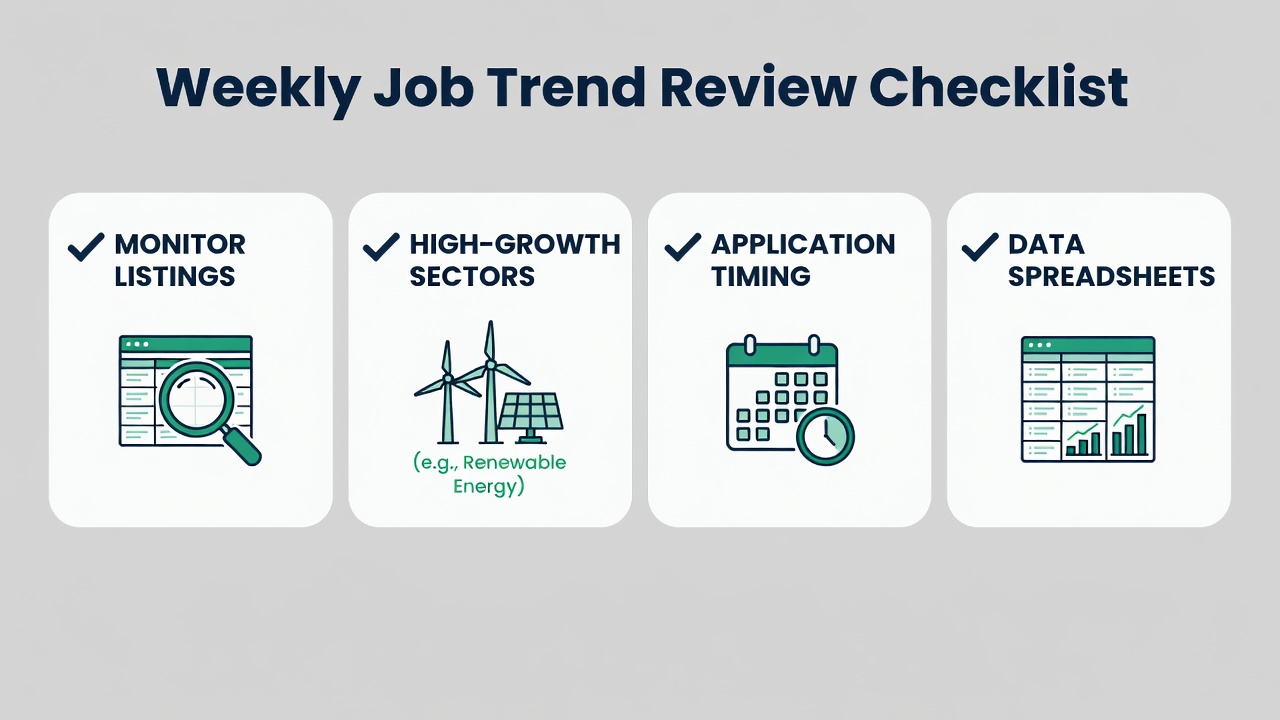
- Review BLS employment situation report for new sector data every Monday morning and note any shifts in unemployment rates or industry growth.
- Scan three major job boards for volume changes in target roles, recording the number of new postings versus prior weeks.
- Update a spreadsheet with application success rates and timing notes to identify patterns in response times.
- Identify two emerging keywords from high-growth listings and refresh your profile and resume accordingly.
- Schedule outreach to three companies in expanding industries via LinkedIn or email with personalized value propositions.
- Evaluate saturated fields by checking applicant-to-opening ratios and pause applications there for the week if ratios exceed sustainable levels.
- Review one industry report or webinar recording to stay informed on emerging skills requirements.
Common Mistakes to Avoid
Many intermediate job seekers overlook the importance of consistent data review and instead chase every trending title. Another frequent error is failing to diversify across sectors, which leaves candidates vulnerable when one area cools. Ignoring timing signals, such as applying late in the week, also reduces visibility. Finally, neglecting to track personal metrics means missing opportunities to refine approaches based on real results.
FAQs on Timing Applications and Avoiding Saturated Fields
When is the best time to submit applications in 2026?
Applications submitted Tuesday through Thursday mornings typically receive faster responses, as recruiters process new postings during peak review periods. Avoid weekends when visibility drops significantly.
How can I identify and avoid oversaturated job markets?
Monitor application-to-opening ratios on job boards. If a field shows more than 200 applicants per role consistently, pivot to adjacent growing niches using skills transfer analysis and keyword mapping.
Should I still use AI tools alongside trend analysis?
Yes, but integrate them strategically. Use AI for resume tailoring after identifying high-potential sectors through data, rather than applying broadly without context.
Conclusion
By integrating these data-driven tactics into your routine, you position yourself ahead of the curve in the 2026 job market. Consistent trend monitoring combined with sector-specific adaptations leads to faster, more efficient outcomes and better long-term career alignment.


No comments yet. Be the first!