 Jobboy

Why Decoding Job Descriptions is Crucial for Job Seekers
In today's competitive job market, landing an interview is just the beginning. To truly stand out, you need to understand exactly what employers are looking for. Job descriptions are more than just listings of duties—they're blueprints of the skills, experiences, and qualities that make a candidate ideal for the role. By decoding these documents, you can tailor your resume, cover letter, and interview responses to match the employer's needs precisely.
Many job seekers skim through postings, missing subtle cues about required competencies. This guide will teach you how to analyze keywords and phrases systematically. Whether you're a recent graduate or a seasoned professional switching careers, mastering this skill can significantly boost your chances of success. According to career experts, aligning your application with job description elements increases interview callbacks by up to 30%.
Step 1: Identify the Core Responsibilities
Start by reading the job description from top to bottom, but pay special attention to the 'Responsibilities' or 'Duties' section. This is where the day-to-day tasks are outlined, revealing the practical skills needed. Look for action verbs like 'manage,' 'develop,' 'analyze,' or 'collaborate.' These indicate the level of autonomy and expertise required.
For example, if the description says 'Lead a team of five in project delivery,' it's not just about leadership—it's about proven experience in team management, project timelines, and possibly tools like Agile methodologies. Jot down these verbs and pair them with any mentioned outcomes, such as 'improve efficiency by 20%,' to understand performance expectations.
- Scan for quantifiable achievements: Numbers often signal the impact desired.
- Note industry-specific terms: In tech roles, words like 'API integration' or 'cloud computing' are red flags for must-have technical knowledge.
- Highlight soft skills: Phrases like 'foster a positive work environment' point to interpersonal abilities.
By breaking down responsibilities, you'll see the role's scope and prepare stories from your experience that demonstrate similar accomplishments.
Step 2: Unpack the Required Qualifications and Skills
The 'Requirements' or 'Qualifications' section is gold for decoding skills. Here, employers list must-haves versus nice-to-haves. Distinguish between hard skills (technical proficiencies) and soft skills (behavioral traits). Hard skills might include 'proficiency in Python' or '3+ years in sales,' while soft skills could be 'strong communication' or 'adaptability.'
Use a highlighter or digital tool to mark keywords. Tools like applicant tracking systems (ATS) scan resumes for these exact terms, so mirroring them in your application is key. If the job requires 'experience with CRM software,' think about your history with Salesforce or HubSpot and how it translates.
- List all technical skills mentioned.
- Identify education or certification needs, like a bachelor's degree or PMP certification.
- Assess experience levels: Entry-level roles might emphasize 'eagerness to learn,' while senior positions demand 'proven track record.'
Don't overlook implied skills. For instance, a marketing role mentioning 'content creation for social media' implies creativity, SEO knowledge, and analytics tools like Google Analytics.
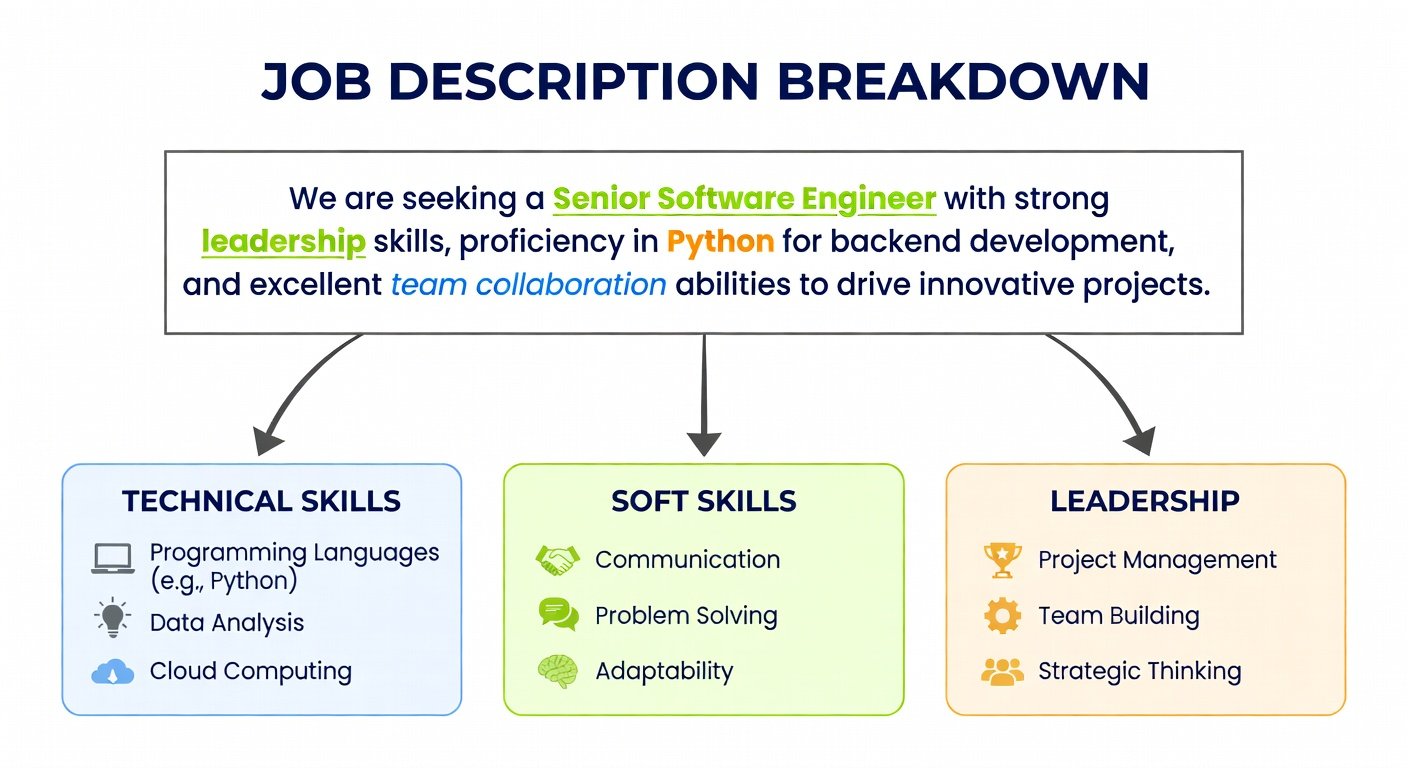
Step 3: Analyze Keywords and Industry Jargon
Job descriptions are packed with keywords that reflect company culture and priorities. Beyond obvious terms, look for recurring themes. If 'innovation' or 'customer-centric' appears multiple times, the company values forward-thinking and client-focused approaches.
To decode effectively, create a keyword inventory. Categorize them into themes: technical, behavioral, and cultural fit. For behavioral keywords, prepare STAR (Situation, Task, Action, Result) stories that showcase them. For cultural fit, research the company's values on their website—does 'fast-paced environment' mean you need to highlight your ability to multitask under pressure?
Pro tip: Use free tools like Google Keyword Planner to understand related terms, but focus on the description's language. This alignment not only passes ATS filters but also shows genuine interest during interviews.
Step 4: Tailor Your Interview Preparation
Once decoded, use the insights to prepare targeted answers. For every key skill, recall a relevant example from your career. If 'data analysis' is crucial, practice explaining how you used Excel or Tableau to drive decisions.
Anticipate questions based on the description. Responsibilities often inspire behavioral interviews: 'Tell me about a time you managed a challenging project.' Prepare 3-5 stories that cover multiple skills, adapting them as needed.
Also, prepare questions for the interviewer. Ask about challenges in the role or team dynamics, drawing from the description to show you've done your homework. This demonstrates enthusiasm and fit.
Common Pitfalls to Avoid When Decoding Job Descriptions
Even savvy job seekers make mistakes. One common error is ignoring company-specific lingo—generic applications get lost in the shuffle. Another is overemphasizing unrelated experience; focus on transferable skills instead.
Avoid assuming qualifications are flexible; if a role requires five years of experience, highlight equivalent achievements if you fall short. Finally, don't neglect the 'Preferred Qualifications'—these can set you apart from other candidates.
Real-World Example: Decoding a Marketing Manager Role
Consider a sample job description: 'Seeking a Marketing Manager to oversee digital campaigns, analyze ROI, and collaborate with sales teams. Requires 5+ years in digital marketing, expertise in Google Ads, and strong analytical skills.'
Key takeaways: Focus on digital tools (Google Ads), metrics (ROI analysis), and cross-functional collaboration. In your interview, share a story about a campaign that boosted leads by 25% using similar strategies. This direct alignment turns a generic response into a compelling one.
For more on digital marketing trends, check out resources from Think with Google, Google's insights hub for marketers.
Leveraging Tools and Resources for Deeper Analysis
Enhance your decoding with online resources. Job boards like Indeed offer tips on reading postings. For ATS optimization, LinkedIn's career advice section provides valuable guidance.
Explore LinkedIn Learning for courses on resume tailoring and interview prep. These platforms help you build the skills highlighted in descriptions, making you a stronger candidate overall.
Final Thoughts: Turn Insights into Action
Decoding job descriptions isn't just about reading between the lines—it's about transforming those lines into your personal roadmap to success. By identifying crucial skills and experiences, you'll approach applications and interviews with confidence and precision. Start practicing on your next job search, and watch how it elevates your results. Remember, the best candidates aren't just qualified; they're the ones who clearly understand and embody what the role demands.


No comments yet. Be the first!